How Many Grafts Do I Need for a Hair Transplant?
Learn how many grafts you need for a hair transplant based on your Norwood stage, treatment zone, and hair characteristics. Includes graft count ranges, session limits, and what to expect during your consultation.
How Many Grafts Do I Need for a Hair Transplant?
"How many grafts do I need?" is the single most common question patients ask before committing to a hair transplant in Algonquin, IL. It is a smart question because the graft count directly shapes your results, your timeline, and your investment. At DSI Hair in Algonquin, IL, Dr. Vic Khanna and his team hear it in nearly every consultation, and the honest answer is always the same: it depends on your unique anatomy, your degree of hair loss, and your restoration goals.
This guide breaks down everything you need to know about graft counts, from what a graft actually is to how surgeons calculate your personalized estimate. Whether you are researching early-stage hairline refinement or full-scalp restoration, you will leave with a clear framework for understanding the numbers.
What Is a Hair Graft?
A hair graft is a small unit of tissue containing one or more hair follicles that is harvested from a donor area (typically the back and sides of the scalp) and transplanted into a thinning or bald region. The term "graft" and "follicular unit" are used interchangeably in modern hair restoration.
Single-Hair vs. Multi-Hair Follicular Units
Not every graft contains the same number of hairs. Naturally occurring follicular units can contain anywhere from one to four individual hair shafts:
- 1-hair grafts: Used primarily along the frontal hairline to create a soft, natural-looking border. These mimic the fine, single hairs that exist at the natural hairline edge.
- 2-hair grafts: The most common follicular unit type. These provide good coverage and density behind the hairline and throughout the mid-scalp.
- 3- to 4-hair grafts: Placed in areas where maximum density is needed, such as the crown or mid-scalp. These units deliver the most coverage per graft.
On average, each graft contains approximately 2.2 hairs. So a procedure involving 2,000 grafts transplants roughly 4,400 individual hairs. This distinction matters because graft count alone does not tell the full story. A patient whose donor area yields predominantly 3-hair grafts will achieve greater density per graft than someone with mostly 1-hair units.
How Grafts Are Counted
During a procedure, trained technicians count every graft under magnification as it is prepared for placement. Modern clinics using the ARTAS robotic hair transplant system benefit from automated tracking that logs each extraction in real time. This ensures accuracy and allows the surgical team to maximize the yield from your donor area.
How Many Grafts Do You Need? Estimates by Norwood Stage
The Norwood-Hamilton scale is the standard classification system for male pattern baldness, ranging from Stage 1 (no significant loss) to Stage 7 (extensive loss). Your Norwood stage provides the starting point for estimating how many grafts you need, though individual variation means these ranges are guidelines rather than guarantees.
Norwood Stage 2 (Mild Recession)
Characterized by slight recession at the temples, often described as a "mature hairline." Many men at this stage are not yet candidates for transplantation, but those who want to restore a more youthful hairline typically need:
- Estimated grafts: 500 - 1,500
- Primary zone: Frontal hairline and temple points
- Sessions: 1
Norwood Stage 3
Deeper temporal recession creates a visible M-shaped or U-shaped pattern. This is the earliest stage where most surgeons agree transplantation is clearly beneficial.
- Estimated grafts: 1,000 - 2,000
- Primary zone: Hairline, temples, and early frontal thinning
- Sessions: 1
Norwood Stage 3 Vertex
Stage 3 recession combined with early thinning at the crown (vertex). Requires grafts in two separate zones.
- Estimated grafts: 1,500 - 2,500
- Primary zones: Hairline and crown
- Sessions: 1 - 2
Norwood Stage 4
Significant frontal and temporal recession with a distinct bald area forming at the crown. A bridge of hair still separates the two zones.
- Estimated grafts: 2,000 - 3,000
- Primary zones: Frontal, mid-scalp, and crown
- Sessions: 1 - 2
Norwood Stage 5
The bridge between the frontal and crown zones has thinned substantially. The two areas of loss are beginning to merge.
- Estimated grafts: 2,500 - 4,000
- Primary zones: Frontal through crown
- Sessions: 1 - 2
Norwood Stage 6
The frontal and crown bald areas have merged. Only a horseshoe-shaped fringe of hair remains along the sides and back.
- Estimated grafts: 3,500 - 5,500
- Primary zones: Full scalp (front to crown)
- Sessions: 2 - 3
Norwood Stage 7
The most advanced stage. Only a narrow band of hair persists at the sides and back. Donor supply is the limiting factor.
- Estimated grafts: 5,000 - 7,000+
- Primary zones: Full scalp coverage
- Sessions: 2 - 3 (spaced 8-12 months apart)
Keep in mind that patients at Norwood 6 and 7 may not have sufficient donor hair to achieve full density across the entire scalp. In these cases, Dr. Khanna works with patients to prioritize the zones that will deliver the most impactful visual result, typically the hairline and frontal third.
Hairline Restoration vs. Crown vs. Full Scalp
Where you need grafts matters just as much as how many you need. Different scalp zones have different density requirements and aesthetic priorities.
Hairline and Frontal Zone
The hairline frames your face and has the biggest impact on perceived age and appearance. It demands the most precision: single-hair grafts at the leading edge, gradually transitioning to multi-hair units behind it. A receding hairline treatment focused on the frontal zone typically requires 1,000 to 2,500 grafts depending on how far back the recession extends.
Mid-Scalp
The area between the hairline and the crown. Thinning here creates a see-through appearance that is especially visible under overhead lighting. Restoring the mid-scalp typically adds 800 to 2,000 grafts to the total count, depending on the area involved and the desired density.
Crown (Vertex)
The crown is a spiral growth pattern at the top of the head. Because hair radiates outward from a central whorl, more grafts per square centimeter are needed to create the appearance of coverage compared to the frontal zone. Crown restoration alone may require 1,500 to 3,000 grafts. However, many surgeons (including Dr. Khanna) recommend prioritizing the hairline first, because a well-framed face with modest crown thinning looks more natural than a full crown with a receded hairline.
Full Scalp Restoration
Patients who need grafts in all three zones (hairline, mid-scalp, and crown) will typically require 3,500 to 7,000+ grafts across multiple sessions. Strategic planning is essential to allocate the finite donor supply across the largest possible surface area while maintaining natural-looking density.
What Determines Your Graft Count?
The Norwood stage gives a ballpark, but your actual graft count depends on several individual factors that only an in-person evaluation can assess.
Hair Density Goals
Normal scalp density is approximately 80 to 120 follicular units per square centimeter. Most transplant procedures aim for 30 to 50 FU/cm2, which creates the visual appearance of a full head of hair without exhausting the donor supply. Patients who want maximum density will need more grafts per zone.
Native Hair Characteristics
Coarse, wavy, or curly hair provides more coverage per graft than fine, straight hair. A patient with thick, dark, wavy hair may achieve satisfactory results with 20-30% fewer grafts than someone with fine, light-colored, straight strands. Hair-to-skin color contrast also plays a role: a patient with dark hair and light skin has less natural camouflage than someone with blonde hair and fair skin.
Scalp Laxity
Scalp laxity refers to how loose or tight the scalp skin is. Patients considering FUE vs FUT comparison should know that FUT (strip) procedures require adequate laxity to close the donor incision, while FUE does not. However, laxity also affects how closely grafts can be packed together in the recipient area.
Donor Area Capacity
The donor area (the permanent zone on the back and sides of the scalp) has a finite number of available grafts. For most patients, the lifetime donor supply ranges from 6,000 to 8,000 FUE grafts. A skilled surgeon must consider not just what you need today but what you may need in the future as hair loss progresses. This is why conservative planning in younger patients is so important.
Future Hair Loss Progression
A 25-year-old at Norwood 3 may eventually progress to Norwood 5 or 6. If all available donor grafts are used to restore the current hairline, there will be nothing left for future procedures. Dr. Khanna factors age, family history, and the pattern of loss into every graft plan to ensure long-term viability. Adjunct therapies like PRP hair restoration can help slow progression and preserve native hair between procedures.
Maximum Grafts in One Session
One of the most frequently asked questions is how many grafts can be transplanted in a single sitting. The answer depends on the technique, the surgical team, and the patient's physiology.
Typical FUE Session Limits
A standard FUE session typically transplants between 2,000 and 3,000 grafts over 6 to 8 hours. Advanced clinics with experienced teams and robotic assistance (such as the ARTAS system used at DSI Hair) can push this to 3,500 to 4,500 grafts in a single extended session.
Why Mega-Sessions Carry Risk
"Mega-session" is a marketing term for procedures exceeding 4,000 to 5,000 grafts in one sitting. While the concept sounds appealing (one procedure, maximum grafts), there are real risks:
- Graft desiccation: Grafts extracted early in the session wait hours to be placed. Extended time outside the body reduces survival rates.
- Surgeon and team fatigue: A 10- to 12-hour procedure demands sustained precision. Fatigue increases the risk of graft handling damage and placement errors.
- Recipient site trauma: Creating thousands of recipient sites in one session can cause excessive swelling and reduced blood flow, both of which impair graft survival.
- Donor overexploitation: Harvesting too many grafts in one session can leave visible thinning in the donor area.
For patients needing more than 4,000 grafts, two well-planned sessions spaced 8 to 12 months apart almost always yield better overall density than a single aggressive mega-session.
Graft Survival Rate: What Percentage Actually Grow?
Not every transplanted graft survives and produces new hair. Understanding survival rates helps you set realistic expectations and appreciate why surgical technique matters so much.
Expected Survival Rates
In the hands of an experienced surgeon using modern techniques, graft survival rates typically range from 90% to 95%. This means that in a 2,500-graft procedure, approximately 2,250 to 2,375 grafts will establish blood supply in their new location and begin producing hair within 3 to 4 months.
Factors That Affect Survival
- Surgeon skill: Precise extraction and placement minimize trauma to the follicle. The angle, depth, and direction of each recipient site directly impact whether the graft thrives.
- Graft handling: Time spent outside the body, storage solution quality, and temperature control all influence viability. The ARTAS robotic system reduces handling time by automating extraction.
- Patient compliance: Following post-operative instructions (avoiding strenuous activity, protecting grafts from trauma, taking prescribed medications) has a measurable impact on survival.
- Recipient site vascularity: Good blood supply in the recipient area supports graft nourishment. Scarred or previously operated areas may have reduced vascularity.
A 5% to 10% non-survival rate is factored into graft planning. If a patient needs 2,000 surviving grafts for adequate density, the surgeon may plan for 2,100 to 2,200 grafts to account for expected attrition.
How a Surgeon Calculates Your Graft Estimate
Online graft calculators and Norwood-based estimates are useful starting points, but they cannot replace a hands-on clinical assessment. Here is what happens during a professional graft count consultation.
The Assessment Process
- Scalp examination: The surgeon evaluates your current hair loss pattern, miniaturization (thinning of existing hairs that signals future loss), and the quality of your donor area under magnification.
- Donor density measurement: Using a densitometer or trichoscopy, the surgeon counts follicular units per square centimeter in the donor zone. Average donor density is 65 to 85 FU/cm2. This measurement determines how many grafts can be safely harvested.
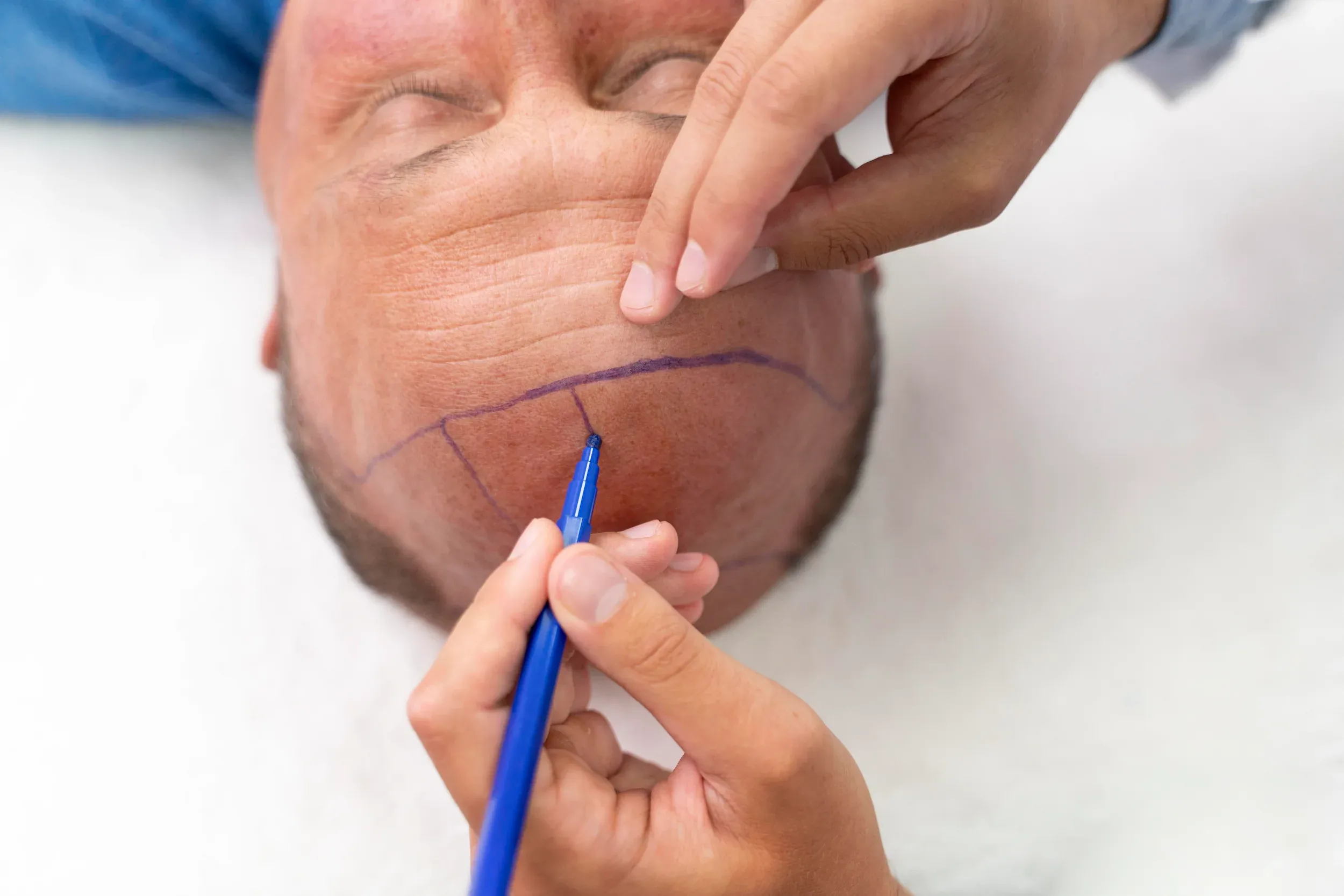
- Recipient area mapping: The surgeon outlines the areas that need coverage, calculates the surface area in square centimeters, and determines the target density (FU/cm2) for each zone.
- Graft math: Surface area (cm2) multiplied by target density (FU/cm2) equals the total graft count. Example: a 50 cm2 recipient area at a target of 40 FU/cm2 requires 2,000 grafts.
- Long-term planning: For younger patients or those with progressive loss, the surgeon builds a multi-session plan that reserves donor capacity for future needs.
At DSI Hair, Dr. Khanna uses high-resolution scalp imaging alongside the ARTAS system's AI-powered mapping to generate precise graft estimates. This combination of clinical experience and technology ensures that your plan is tailored to your anatomy, not a generic chart.
Cost Implications of Graft Count
Graft count is the primary driver of hair transplant cost. Understanding how pricing works helps you budget realistically and compare quotes intelligently.
Per-Graft Pricing
Most hair transplant clinics price procedures on a per-graft basis. In the United States, per-graft pricing for FUE procedures typically ranges from $4 to $10 per graft depending on the clinic's location, the surgeon's experience, and the technology used. Robotic-assisted FUE procedures may carry a modest premium due to the precision and consistency the technology provides.
What the Numbers Look Like
- 1,500 grafts (mild recession): $6,000 - $15,000
- 2,500 grafts (moderate loss): $10,000 - $25,000
- 4,000 grafts (extensive restoration): $16,000 - $40,000
Why the Cheapest Option Is Rarely the Best
Hair transplant pricing that seems too good to be true usually is. Clinics offering unusually low per-graft rates may be cutting corners on graft handling, using less experienced technicians for critical steps, or inflating graft counts. A graft that does not survive is a graft you paid for but will never see. Investing in an experienced, board-certified surgeon with a track record of natural-looking results is the most cost-effective decision in the long run.
Frequently Asked Questions
How many grafts do I need for a full head of hair?
Most patients need between 4,000 and 7,000 grafts across multiple sessions for comprehensive full-scalp coverage. However, "full head of hair" does not require restoring every follicle you had at age 18. Strategic placement of 3,000 to 5,000 grafts can create the visual illusion of a full head of hair by framing the face with a natural hairline and establishing adequate mid-scalp density. Your surgeon will help define a realistic goal based on your donor supply and coverage priorities.
Is 2,000 grafts enough for a hair transplant?
Yes, for many patients. A 2,000-graft procedure is well-suited for Norwood 2 to 3 patients who primarily need hairline restoration and frontal density. At approximately 2.2 hairs per graft, that is roughly 4,400 hairs, enough to make a significant visual difference in the frontal zone. Patients with more advanced loss will likely need additional grafts in a subsequent session.
How many grafts for hairline restoration?
Hairline-only restoration typically requires 1,000 to 2,500 grafts depending on the degree of recession and the desired hairline position. A conservative, age-appropriate hairline might need 1,000 to 1,500 grafts. A more aggressive restoration that extends the hairline forward and fills in the temple peaks may require 2,000 to 2,500 grafts.
What is the maximum number of grafts in one session?
Most experienced FUE surgeons can safely transplant 2,000 to 3,500 grafts in a single session. With robotic assistance and an experienced team, sessions of 4,000 to 4,500 grafts are possible but approach the upper limit of what can be done safely. Beyond 4,500 grafts, the risks of reduced graft survival, donor area damage, and surgeon fatigue increase substantially.
Can I need more grafts in a second procedure?
Absolutely. There are two common reasons for a second procedure: planned multi-session restoration (for patients who need more grafts than can be safely done in one sitting) and progressive hair loss (new thinning that develops years after the initial transplant). This is why donor conservation is a key part of surgical planning. A responsible surgeon always reserves enough donor capacity for potential future needs.
How does hair density affect graft count?
Hair density affects graft count in two ways. First, your existing native density in thinning areas determines how many grafts are needed to reach your target density. An area with 30 FU/cm2 of native hair needs fewer grafts than an area with 10 FU/cm2 to reach the same visual density. Second, your donor area density determines how many grafts are available for harvest. Higher donor density means more grafts can be extracted without visible thinning of the donor zone.
How accurate are online graft calculators?
Online graft calculators provide rough estimates that can be useful for initial research but are not reliable for surgical planning. They typically rely on self-assessed Norwood stage and cannot account for hair caliber, donor density, scalp laxity, miniaturization patterns, or the patient's aesthetic goals. Studies have shown that online estimates can differ from clinical assessments by 30% to 50% in either direction. Always get an in-person evaluation before making decisions based on graft numbers.
Do ARTAS robotic transplants have different graft limits?
The ARTAS robotic system does not inherently change the maximum number of grafts that can be transplanted, but it does improve efficiency and consistency during the extraction phase. The robot's AI-guided selection algorithm identifies optimal donor follicles and extracts them with consistent depth and angle, which reduces transection (damage to the follicle during extraction) rates. This precision can mean that a higher percentage of harvested grafts are viable, effectively improving the "yield" per session. At DSI Hair, Dr. Khanna combines ARTAS extraction with meticulous hand-placed recipient sites for the best of both approaches.
Get Your Personalized Graft Estimate
The numbers in this guide give you a framework, but your hair, your scalp, and your goals are unique. The only way to get an accurate graft count is through a one-on-one consultation with an experienced hair restoration surgeon who can examine your donor area, map your recipient zones, and build a plan tailored to you.
At DSI Hair in Algonquin, IL, Dr. Vic Khanna offers complimentary hair transplant consultations that include high-resolution scalp analysis, a personalized graft estimate, and a transparent discussion of expected results and costs. Whether you are exploring options for the first time or comparing surgical plans, this is the most valuable step you can take.
Call (844) 307-7546 or contact us online to schedule your free consultation.